
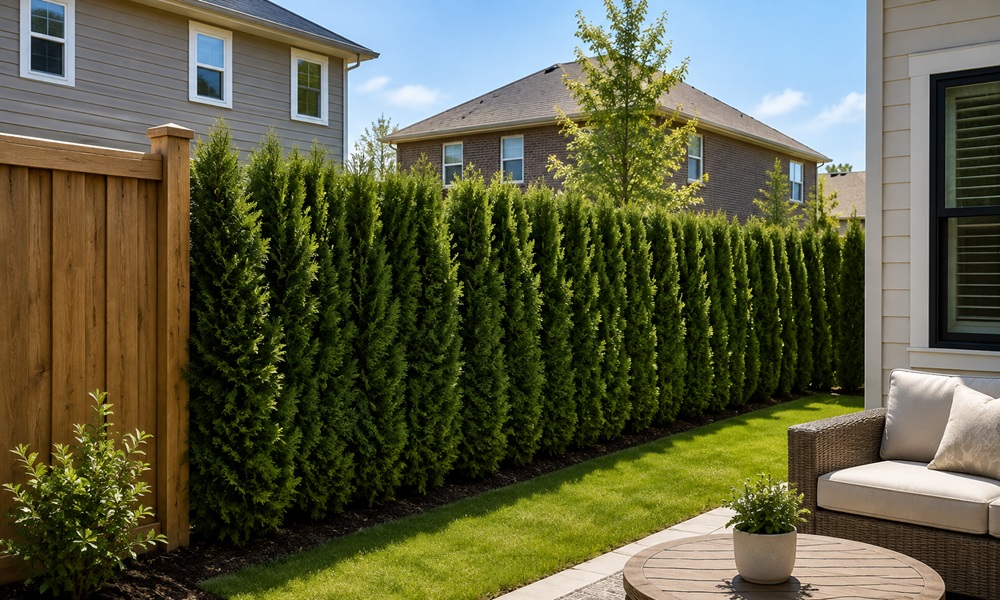
You want to drink your morning coffee without making eye contact with the person next door. Fair.
Whether the neighbor is a few feet away, looking down from a second-story window, or just a little too visible over a short fence, there is a privacy solution that fits your space, your budget, and your style.
The trick is matching the right barrier to your exact situation. A ground-level neighbor and a two-story window need very different answers.
Quick answer: The best options fall into four groups: built structures (privacy fences, wood-slat screens, pergolas, lattice panels), living barriers (hedges, evergreens, bamboo in planters, climbing vines on a trellis), soft screens (mesh panels, outdoor curtains, shade sails), and layered combinations of all three. The single most important decision is not what you build but where you place it. Screening close to your seating area blocks more of the view with far less material than a wall on the property line.
What are the main ways to add privacy between houses?
Every solution is a variation on four categories. Pick based on how fast you need coverage, how much you want to spend, and how it should look.
| Type | Examples | Speed | Look | Best for |
|---|---|---|---|---|
| Built structures | Privacy fence, slat screen, pergola, lattice | Instant | Clean, architectural | Immediate, defined privacy |
| Living barriers | Hedges, evergreens, bamboo, climbing vines | Slow to grow | Natural, soft | Long-term, greener screening |
| Soft screens | Mesh panels, outdoor curtains, shade sails | Instant | Casual, flexible | Renters and adjustable privacy |
| Layered mix | Structure plus plants plus soft elements | Mixed | Rich and deliberate | The most private and stylish result |
Built structures: fast, defined privacy
When you want privacy now, you build it.
Privacy fence. The classic. If the neighbor is very close, a solid fence with boards butted together (no gaps) gives full screening. If they are farther off, a slat or trellis-style fence looks nicer and still does the job.
Staggered or slatted screen. Wooden planks set at varying heights or with small gaps create an eye-catching screen that still lets air through. You can adjust the gap size to trade a little privacy for more light and breeze. Staggered designs handle wind better than a solid wall.
Freestanding screen or partition. A standalone panel you place exactly where the sightline is. Build it, move it, or cover it in vines. Very flexible.
Pergola or partially enclosed structure. Great over a patio, and the overhead element is what you need when the neighbor is looking down from above.
Lattice panels. Affordable, light, and perfect as a base for climbing plants. Flank a lattice screen with outdoor curtains for a soft, finished look.
Living barriers: natural and beautiful
Plants soften everything and, over time, disappear the boundary into greenery.
- Evergreen hedges and trees give year-round coverage. The trade-off is patience, since most take years to fill in.
- Bamboo in large planters grows fast and tall for a quick green wall. Use containers or a root barrier so it does not spread where you do not want it.
- Climbing vines on a trellis or arbor are the shortcut. A trellis gives instant structure, and vines like jasmine or ivy cover it within a season or two.
- Tall ornamental grasses in planters offer a movable, feathery screen for decks and patios.
A smart move: plant fast growers in front of slow growers. The fast plants screen you now while the permanent hedge matures behind them.
Soft screens: flexible and renter-friendly
No digging, no permits, no commitment.
- Mesh privacy panels attach to gazebos, pavilions, and railings. Look for zippered panels so you can switch between full privacy and open air.
- Outdoor curtains on a rod or wire give a resort-patio feel and pull open when you want the view back.
- Shade sails and canopies block the overhead sightline from a two-story neighbor and add welcome shade.
- Planters on wheels let you roll a screen into place for a party and roll it away after.
The placement secret most guides get backward
Here is the insight that changes everything, and almost every listicle misses it.
Your instinct is to build a barrier right on the property line. Landscape architects say that is often the wrong spot.
Screen close to where you actually sit, not at the far boundary.
Why it works comes down to a cone of vision. You do not need to block the whole yard. You only need to interrupt the specific line of sight between the neighbor’s eyes and your chair. A small screen a few feet from your seating area covers that sightline completely.
The same screen placed at the property line, thirty feet away, would need to be enormous to block the same view.
Placing screens closer to the house has a second benefit: counterintuitively, it makes the yard feel bigger, because you are not walling off the whole space, only the part you use.
So before you price out fifty feet of fencing, sit in your favorite spot and notice exactly where the neighbor appears. Block that. You will spend less and enjoy an open yard.
What about a two-story neighbor looking down?
A ground-level fence does nothing against a second-floor window. You need height or an overhead element.
- A pergola, gazebo, or shade sail breaks the downward sightline.
- Tall trees or bamboo placed to intercept the view work over time.
- A taller trellis with a top canopy blocks the angle from above.
You can also, gently, share ideas with the neighbor for screening on their side. Sometimes the easiest privacy fix is a friendly conversation.
Do not forget sound privacy
Visual privacy is only half of feeling unwatched. A water feature or small fountain masks conversation and traffic noise with a pleasant sound. Choose a flow level that soothes rather than overwhelms, and it doubles as an attractive focal point.
Check the rules before you build
A quick reality check saves headaches:
- Height limits. Many areas cap fence height, especially in front yards.
- Setbacks and property lines. Know exactly where your line is before you dig. A misplaced fence is an expensive mistake.
- Permits. Larger structures may need approval and submitted plans.
- HOA rules. If you have a homeowners association, check what materials and heights are allowed.
- Local ordinances. Rules vary widely by location, so confirm what is permitted where you live.
Frequently asked questions
What is the cheapest way to get privacy from neighbors?
Soft screens are the cheapest instant fix: mesh panels, outdoor curtains, or a lattice with climbing vines. Planters on wheels and a single well-placed freestanding screen also deliver a lot of privacy for little money.
What is the fastest-growing plant for privacy?
Bamboo in containers is one of the fastest tall screens. Climbing vines on a trellis also fill in quickly. For instant green, plant fast growers in front of a slower permanent hedge.
Where should I place a privacy screen?
Close to your seating area, not on the property line. A small screen near where you sit blocks the exact line of sight with far less material, and it keeps the yard feeling open and larger.
How do I get privacy from a second-story neighbor?
Use height and overhead cover. A pergola, shade sail, tall trees, or a trellis with a canopy breaks the downward angle that a normal fence cannot reach.
Do I need a permit to put up a privacy screen?
It depends on where you live and how large the structure is. Freestanding screens and planters usually do not, while taller fences and permanent structures often do. Check local rules and any HOA guidelines first.