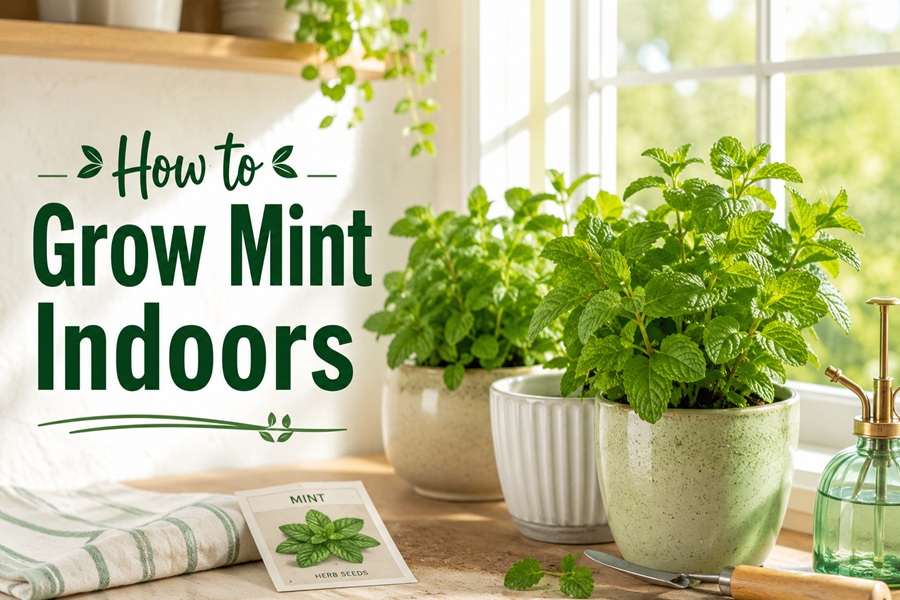
Quick answer: To grow mint indoors, start a 4 to 6 inch cutting in water or moist potting mix, then move it to a pot with drainage holes once it roots. Give it the brightest window you have (four to six hours of direct light), keep the soil consistently moist but never soggy, and trim it every few weeks to force bushy growth. The number one reason indoor mint fails is not enough light, which makes it stretch tall, pale, and leggy.
Mint is one of the easiest herbs to keep on a windowsill, and unlike most houseplants it keeps growing right through winter. Get the light and the pruning right and you will have fresh leaves year-round. This guide covers starting it, the conditions it needs, and how to keep it lush instead of straggly.
Can you grow mint indoors year-round?
Yes, and it is one of the best herbs for it. An indoor mint plant gives you fresh leaves in every season, and growing it in a pot has a hidden bonus: it contains mint’s aggressive roots, which would otherwise take over a garden bed.
Here are the conditions to aim for at a glance:
| Need | What mint wants |
|---|---|
| Light | Bright, 4 to 6 hours direct, or a grow light up to 14 hours |
| Water | Consistently moist, never waterlogged |
| Soil | Well-draining potting mix, slightly acidic to neutral (pH 6.0 to 7.0) |
| Pot | At least 8 inches deep with drainage holes |
| Temperature | Warm but not hot, away from radiators and scorching glass |
| Feeding | Light liquid feed every few weeks in the growing season |
How do you start mint indoors from a cutting?
Cuttings are the easiest and most reliable start. Seeds are trickier, because mint varieties cross-pollinate and seed-grown plants can be unpredictable. If you have access to any healthy mint plant, take a cutting.
- Cut a 4 to 6 inch stem just below a leaf node, using clean scissors.
- Strip the lower leaves, leaving a couple of sets at the top. Save the removed leaves for tea.
- Rooting hormone is optional, not needed.
Then root it one of two ways:
In water:
- Stand the cutting in a jar with about an inch of water, in bright, indirect light.
- Change the water every day or two so it stays fresh.
- Roots appear in one to two weeks. Pot it up once the roots reach about an inch, and do not wait too long, or it struggles to adjust to soil.
In soil:
- Push the bare stem into moist potting mix.
- To boost humidity, cover the pot loosely with a clear plastic bag on a windowsill.
- Keep it out of harsh direct sun for the first week while it settles, then move it into bright light. Roots establish in about three weeks.
What kind of pot and soil does indoor mint need?
Mint has a vigorous root system, so give it room. Choose a pot at least 8 inches deep and 10 to 12 inches wide, and make sure it has drainage holes. Sitting in trapped water causes root rot fast.
For soil, use a well-draining potting mix rich in organic matter, ideally slightly acidic to neutral. Mixing in a little perlite or vermiculite improves drainage and airflow to the roots. Set the plant so its leaves sit level with the pot rim.
How much light does mint need indoors?
This is the make-or-break factor. Indoor mint needs far more light than outdoor mint. Outside it tolerates shade, but inside, weak light makes it stretch toward the window, grow pale, and turn leggy.
- Place it in your brightest window, ideally south or west facing, for four to six hours of direct light.
- If your light is limited, add a grow light for up to 14 hours a day.
- Rotate the pot every few days so all sides get light evenly and the plant does not lean.
How often should you water indoor mint?
Mint likes to stay consistently moist, but hates sitting in water. Aim for the middle.
- Water when the top inch of soil feels dry.
- Give it a proper soak. Moving the pot to the sink and letting water flush through, then drain, works well.
- Never let the pot stand in a saucer of water. Good drainage prevents root rot.
- Mint enjoys humidity, so an occasional misting of the leaves helps, especially in dry, heated rooms.
Keep it warm but not baking. Right against a hot radiator or scorching glass, mint wilts and dries out.
Should you feed indoor mint?
A little. Because indoor mint keeps growing through winter, a light feed keeps it productive.
- In the main growing season, use a liquid organic fertilizer every three weeks or so, mixed per the label.
- If you are harvesting all winter, feed roughly every six weeks in the colder months.
- Do not overdo it. Too much feed pushes weak, floppy growth.
How do you harvest mint so it stays bushy?
Regular trimming is not just for the kitchen, it is what keeps the plant compact and full. Left uncut, mint gets tall and sparse.
- Give it a “haircut” every few weeks, snipping stems back with herb scissors.
- Always cut just above a leaf node. The plant responds by branching into two new stems there, which is how you build a bushy plant.
- Avoid taking more than about a third of the plant at once, so it can bounce back.
- Frequent light harvests beat rare heavy ones.
Why is my indoor mint leggy, wilting, or dying?
The common problems and their fixes:
- Leggy, pale, stretched growth: not enough light. Move to a brighter spot or add a grow light, and prune to encourage branching.
- Wilting despite watering: likely root rot from soggy soil or a pot with no drainage. Let it dry out and check the drainage.
- Dry, crispy leaves: too little water or too much heat. Water more consistently and move it away from radiators.
- Tiny webs or specks on leaves: spider mites or aphids, common indoors. Rinse the leaves and treat with insecticidal soap.
- White powder on leaves: powdery mildew from poor airflow. Improve air circulation and avoid wetting the foliage late in the day.
What do experienced growers say?
Across gardening blogs and herb-growing communities, the advice that comes up again and again from people who keep mint alive indoors:
- Light is everything. The most repeated fix for sad indoor mint is simply moving it to a brighter window or adding a grow light.
- Rotate the pot. Growers note it keeps the plant even instead of one-sided and reaching.
- Prune more than feels comfortable. Regular cutting is what separates a bushy plant from a straggly one, and mint bounces back fast.
- Try different varieties. Spearmint, peppermint, and flavored types like apple, pineapple, and chocolate mint all grow the same way, so it is easy to keep a few.
Frequently asked questions
Does mint grow better in water or soil?
Water rooting is great for starting cuttings and easy to watch. For a long-term productive plant, move it into soil once it roots.
How much sunlight does indoor mint need?
Four to six hours of direct light, or a grow light up to 14 hours a day. More light is almost always better indoors.
Why does my indoor mint keep getting tall and thin?
That is legginess from low light, made worse by not pruning. Brighten its spot and trim it back regularly.
How often should I water potted mint?
When the top inch of soil is dry. Keep it moist but never let the pot sit in water.
Can I grow mint indoors from seed?
You can, but it is less reliable than cuttings because mint varieties cross-pollinate. Cuttings are faster and truer to the parent plant.