Outdoor cushions take a beating. Sun, rain, pollen, sunscreen, spilled drinks, bird droppings, and the odd muddy paw all land on the same seat you want to relax on.
Most guides tell you to scrub with soapy water and rinse. That works, until it does not. Use the wrong cleaner and you strip the fabric’s water repellency. Skip the drying step and mold grows back inside the foam within days.
This guide fixes both problems. You will learn how to clean outdoor cushions by fabric type, lift mold and mildew, remove stubborn stains, and dry them so the mildew does not return.
To clean outdoor cushions, brush off loose debris, vacuum the seams, then scrub with a soft brush and a mix of a few drops of dish soap per gallon of warm water. Rinse thoroughly with a hose. For mold or mildew, use a white vinegar solution on most fabrics, or a diluted bleach and soap solution on solution-dyed acrylic like Sunbrella. Always air dry the cushions completely, standing on their side, before storing them. Test any cleaner on a hidden corner first.
What Is the Fastest Way to Clean Outdoor Cushions?
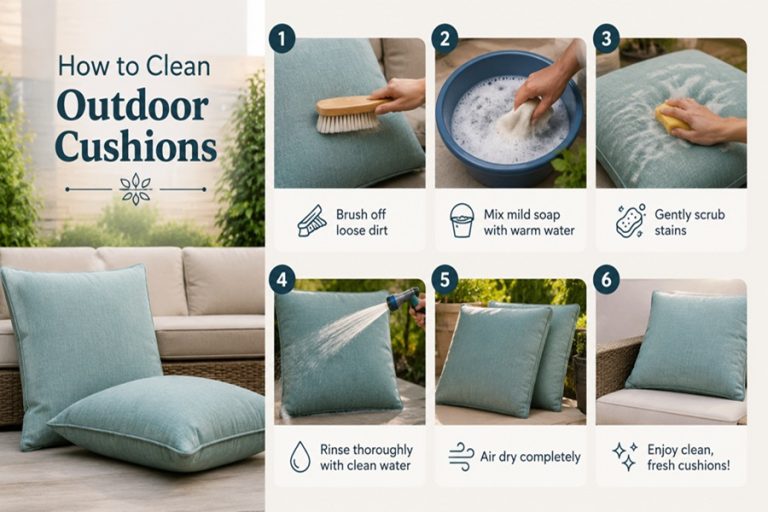
If you only have twenty minutes and the cushions are dirty but not moldy, use this quick routine.
- Brush and shake. Knock off loose dirt, pollen, and crumbs. Cleaning dirt into wet fabric only spreads it.
- Vacuum the seams. Crumbs and spores hide in the piping, buttons, and zipper channels.
- Mix a gentle solution. A few drops of dish soap or a small amount of liquid laundry detergent per gallon of warm water is enough.
- Scrub gently. Use a soft-bristle brush in small circles. Focus on stained spots.
- Rinse fully. Leftover soap attracts dirt faster than bare fabric does.
- Air dry on their side. Stand cushions up so water drains out instead of pooling in the foam.
That covers routine grime. For mold, tough stains, or a full seasonal reset, keep reading. The method that keeps your cushions safe depends on what they are made of.
How Do You Know What Your Outdoor Cushion Fabric Is Made Of?
This is the step almost every article skips, and it is the one that decides everything. The same cleaner that is safe on one fabric fades or ruins another.
Check the care tag first. If the tag is gone, most manufacturers list care instructions on their website. If you still cannot tell, match the feel and behavior below.
| Fabric type | How to spot it | Bleach safe? | Best cleaner |
|---|---|---|---|
| Solution-dyed acrylic (Sunbrella and similar) | Canvas-like, color runs all the way through the fiber, dries fast | Yes, diluted | Mild soap and water, or diluted bleach for mold |
| Olefin / polypropylene | Soft, lightweight, budget outdoor sets | No | Mild soap and water, oxygen bleach |
| Polyester (printed) | Pattern printed on top, color fades if scratched | No | Mild soap, white vinegar |
| Cotton or cotton blend | Soft, absorbs water, slow to dry | No | Mild soap, machine wash if removable |
Why it matters: solution-dyed acrylic is colored in the raw fiber before it is woven, so bleach cannot pull the color out. Printed polyester and dyed cotton hold color only on the surface, so bleach strips it. When in doubt, treat the fabric as bleach-sensitive and reach for vinegar or oxygen bleach instead.
One more truth worth knowing. Fabrics like Sunbrella are marketed as mildew resistant, but that does not make them mildew proof. Mildew still grows on the dirt, pollen, and sunscreen sitting on top of the fabric. Keep the surface clean and you starve the mildew of what it feeds on.
What Supplies Do You Need to Clean Outdoor Cushions?
You likely have most of this already.
- Soft-bristle brush (a hard brush frays the weave)
- Bucket
- Garden hose or spray bottle
- Handheld vacuum or vacuum with a crevice tool
- Mild dish soap or liquid laundry detergent
- Distilled white vinegar
- Baking soda or cornstarch (for oil stains)
- Oxygen bleach such as OxiClean (for tough stains on non-acrylic fabric)
- Chlorine bleach (only for solution-dyed acrylic mold)
- Microfiber cloths
- Rubber gloves
- A tarp or clean hard surface to work on
Work on a deck, driveway, or tarp. Never clean cushions directly on grass, since you will trade dirt stains for grass and mud stains.
How Do You Deep Clean Outdoor Cushions Step by Step?
This is the full method for cushions that need more than a quick wipe. It suits a start-of-season refresh or a mid-summer rescue.
- Prep the area. Lay a tarp on a flat, hard surface. Start early in the day so cushions have hours of daylight to dry.
- Remove loose debris. Brush and shake each cushion, then vacuum the seams, piping, and buttons where spores collect.
- Pretreat visible stains. Spray a 50/50 mix of white vinegar and warm water on dark spots. Let it sit for fifteen to twenty minutes.
- Mix your cleaning solution. For routine cleaning, use a few drops of dish soap or a squirt of laundry detergent per gallon of warm water.
- Scrub seam to seam. Dip the soft brush and work the whole surface in gentle circles, not just the stain. Cleaning the entire panel prevents water rings and blotchy clean patches.
- Let it dwell. Give the solution three to five minutes to break down grime before rinsing.
- Rinse until the water runs clear. Use a hose on a normal setting. Soap left in the fabric attracts new dirt.
- Squeeze and stand to dry. Press out excess water, then stand each cushion on its edge so water drains from the foam. Finish in direct sun if you can.
The seam-to-seam habit in step five comes straight from professional fabric-care guidance. Spot cleaning only the stain often leaves a visible ring where the clean patch meets the dirty fabric. Clean the whole panel and the color stays even.
Can You Machine Wash Outdoor Cushion Covers?
Sometimes, and it is the easiest option when it is allowed.
Check for a zipper. If the cover unzips and the care tag permits it, machine washing saves real effort. Follow these rules:
- Close every zipper before washing so nothing snags.
- Use cold water and the delicate or gentle cycle.
- Use a small amount of mild detergent.
- For solution-dyed acrylic with severe mildew, you can add a cup of bleach, but confirm with the furniture maker first.
- Never machine dry. Air dry only, since heat can shrink covers and warp the fit.
Not all covers are removable, and not all removable ones are washable. When the tag says spot clean only, respect it. Cushion construction varies, and a shrunken cover will never zip back over its foam again.
Should You Pressure Wash Outdoor Cushions?
This is one of the most debated questions online, and the honest answer is: usually no.
A pressure washer can work, but only on a low-pressure nozzle held well back from the fabric. Get too close, or use a high-pressure tip, and the jet tears the weave and blasts water deep into the foam.
That last part is the real risk. Across home and patio threads on Reddit and DIY blogs, the recurring warning is the same. Pressure washing forces water into the foam core, and foam that stays wet inside grows mold you cannot see or reach. People who tried it often report cushions that smelled musty within a week, even though the surface looked spotless.
The practical takeaway from that community consensus:
- For routine cleaning, skip the pressure washer entirely. A soft brush and a hose do the job with none of the risk.
- If you insist on a pressure washer, use the lowest pressure, keep a safe distance, and plan for a very long, thorough drying period.
- After any deep soak, dry the foam completely before the cushions go back on the furniture.
Steam cleaning is a gentler alternative for cushions that cannot be machine washed. Steam lifts dirt, mold, and mildew without soaking the foam, as long as the fabric is steam safe. Check the care tag first.
How Do You Get Mold and Mildew Off Outdoor Cushions?
First, know what you are looking at. Mildew is a surface fungus. It looks flat, powdery, and gray or white, and it brushes off fairly easily. Mold goes deeper. It looks fuzzy or raised and often green or black, and it can stain permanently.
On outdoor cushions you are almost always dealing with mildew, and it is very treatable. Pick the method that matches your fabric.
The vinegar method (safe on most fabrics)
- Brush off loose mildew outdoors, before wetting, so you do not spread spores.
- Mix one cup white vinegar, one tablespoon dish soap, and one gallon of warm water.
- Spray or sponge it onto the affected areas.
- Let it sit for fifteen to twenty minutes.
- Scrub gently with a soft brush in circles.
- Rinse well and air dry in the sun.
The borax method (good for heavier mildew)
Borax is a mineral salt and a proven mildew fighter. Dissolve it in warm water per the package, apply, let it dwell, scrub, and rinse. It works without the color risk of chlorine bleach, which makes it a favorite for fabrics you are unsure about.
The oxygen bleach method (for tough stains on non-acrylic fabric)
Oxygen-based bleach like OxiClean lifts set-in mildew stains without the fading risk of chlorine bleach. Mix per the package, apply to stains, let it sit for about thirty minutes, then scrub and rinse.
The chlorine bleach method (solution-dyed acrylic only)
This is where fabric type matters most, which brings us to the biggest point of confusion online.
Is Bleach Safe on Outdoor Cushions?
You will find guides that swear by bleach and guides that say bleach ruins your cushions. Both are right, for different fabrics. Here is how to reconcile them.
On solution-dyed acrylic such as Sunbrella, chlorine bleach is safe when diluted. The official guidance is one cup of bleach and a quarter cup of mild soap per gallon of water. Spray it on, let it soak for up to fifteen minutes, scrub with a soft brush, and rinse thoroughly. Because the color lives inside the fiber, bleach removes the mildew without removing the color.
On printed polyester, olefin, or cotton, chlorine bleach fades the color and can strip the factory water-repellent finish. On these fabrics, use vinegar, borax, or oxygen bleach instead.
Two cautions almost no consumer article mentions:
- Bleaching removes water repellency. After you use a bleach solution on acrylic, the fabric loses its factory finish. You need to reapply a fabric protector such as a fluorocarbon-based fabric guard to restore water and stain resistance.
- Bleach and the environment do not mix. Do not use bleach near a pond, pool, garden bed, or any water source it can run into. Wear gloves, work in a ventilated area, and rinse completely.
When you are unsure what your fabric is, do not gamble. Treat it as bleach-sensitive and clean with vinegar or oxygen bleach.
How Do You Remove Specific Stains From Outdoor Cushions?
Different messes need different fixes. Here is a stain chart you can bookmark. Always blot, never rub, since rubbing pushes stains deeper.
| Stain | What to use | How to treat |
|---|---|---|
| Oil, sunscreen, grease | Cornstarch or baking soda | Blot excess, cover with powder, wait ten to fifteen minutes, scrape off, then wash with dish soap and water |
| Bird droppings | Microfiber cloth | Lift off as much as possible first, then spot clean; do not rub it in |
| Tree sap | Turpentine or Murphy’s Oil Soap | Soften the sap, scrape off excess, then clean with soap and water |
| Food and drink | Dish soap and water | Blot, then scrub gently with mild soapy water |
| Wine or coffee | White vinegar solution | Blot, apply vinegar and water, let sit, then rinse |
| Mildew spots | Vinegar, borax, or oxygen bleach | Match to fabric type, dwell, scrub, rinse |
The oil trick is worth calling out. A dry powder like cornstarch or baking soda pulls oil up out of the weave before it sets. Scrape the powder off with the edge of a spoon or a squeegee, then vacuum the residue. Reapply if the mark remains.
How Do You Dry Outdoor Cushions So Mold Does Not Come Back?
This is the step that separates cushions that stay fresh from cushions that smell musty in a week. Cleaning removes today’s mildew. Proper drying stops tomorrow’s.
The problem is the foam core. It holds water long after the surface feels dry. Seal damp foam under a cover and you have built the perfect mold incubator.
Dry the right way:
- Stand cushions on their edge, not flat, so gravity pulls water out of the foam.
- Let them dry in direct sun. Sunlight speeds drying and its UV acts as a natural bacteria and odor killer.
- Give it real time. A thick foam cushion can need a full day of dry weather, not an hour.
- Confirm the core is dry, not just the surface. Press firmly in the center. If it feels cool or damp, it is not ready.
- Never store damp cushions. Damp fabric plus a closed deck box equals mildew.
If the weather will not cooperate, dry cushions indoors near a fan, or use a wet vacuum to pull moisture out of the foam after a deep clean.
How Often Should You Clean Outdoor Cushions?
Consistency beats intensity. A quick habit prevents the grime that forces a deep clean. Use this cadence as a starting point and adjust for your climate.
| Task | How often | Why |
|---|---|---|
| Brush off dust and debris | Weekly, or whenever you are out there | Stops dirt from feeding mildew |
| Rinse with a hose | Monthly | Clears embedded pollen and grime |
| Spot clean spills | Immediately | Fresh stains lift far easier than set ones |
| Deep clean | Twice a season | Resets fabric before buildup sets in |
| Reapply fabric protector | After each deep clean | Restores water and stain resistance |
Humid, rainy, or coastal climates need more frequent attention. So does any patio under heavy tree cover, where sap, pollen, and bird droppings pile up fast.
How Do You Keep Outdoor Cushions Clean Longer?
The cheapest cleaning is the one you avoid. A few habits keep cushions fresh and stretch their lifespan by years.
- Apply a fabric protector. A fluorocarbon-based fabric guard restores water and stain repellency after cleaning, so spills bead up instead of soaking in.
- Bring cushions in before heavy rain. Even weather-resistant fabric is more pleasant dry, and non-resistant fabric can soak through and grow mildew.
- Store non-resistant fabrics overnight. Cotton and similar fabrics do not dry easily and struggle with morning dew.
- Use a deck box or storage cover for the off-season, and only after cushions are fully dry.
- Do a ten-second brush-off whenever you pass by. Small, frequent effort beats a weekend of scrubbing.
If pets treat your outdoor sofa as a daybed, vacuum a few times a week. Fur woven into fabric is far harder to remove than fur sitting on top of it.
What Mistakes Should You Avoid When Cleaning Outdoor Cushions?
A few common errors cause most of the damage.
- Skipping the spot test. Always test any cleaner on a hidden corner, like the underside, before you commit.
- Using bleach on the wrong fabric. Great on solution-dyed acrylic, ruinous on printed or dyed fabric.
- Scrubbing too hard with a stiff brush. This frays the weave and wears out the fabric. Gentle circles with a soft brush do more with less damage.
- Leaving soap in the fabric. Residue attracts dirt faster than clean fabric. Rinse until the water runs clear.
- Storing cushions before the foam is dry. The single most common cause of returning mildew.
- Cleaning on grass. You will just swap old stains for green ones.
Is It Cheaper to Clean or Replace Outdoor Cushions?
Almost always cheaper to clean. Replacement cushions for a full patio set can run into the hundreds, while a cleaning session costs the price of soap, vinegar, and an hour of your time.
Cleaning also protects the money you already spent. Performance fabric is built to last for years, but only if the dirt, oils, and mildew that break down fibers are washed off periodically. Regular care is not just about looks. It is the difference between replacing cushions every couple of seasons and keeping them for the better part of a decade.
Replace cushions only when the foam has broken down and lost its support, the fabric is torn or worn through, or mildew has penetrated so deep into the foam that no amount of cleaning removes the smell. Until then, a wash beats a purchase.
Frequently Asked Questions
Can you use a magic eraser on outdoor cushions? For small, localized marks it can help, but test a hidden spot first. Its mild abrasion can dull or lighten some fabrics, so it is not a substitute for a full wash.
How do you clean outdoor cushions that cannot be removed from the frame? Clean them in place. Brush off debris, apply your fabric-appropriate solution seam to seam with a soft brush, rinse with a hose, and let them dry in the sun or under a fan. Steam cleaning also works well when the cushions cannot come off.
Does vinegar damage outdoor fabric? Diluted white vinegar is safe on most outdoor fabrics and is a reliable choice for mold, mildew, and general stains. As always, test a hidden area first, and rinse afterward so no residue is left behind.
How do you get the musty smell out of outdoor cushions? The smell is mildew, and it usually means moisture is trapped in the foam. Clean with a vinegar solution, rinse, then dry the cushions completely in the sun. If the smell survives full drying, the mildew has reached deep into the foam and the cushion may need replacing.
Can you put outdoor cushions in the dryer? No. Heat can shrink covers and warp foam. Always air dry outdoor cushions, standing them on their edge, ideally in direct sunlight.
Cleaning instructions vary by manufacturer. Always check the care label on your specific cushions before using any cleaner, and spot test on a hidden area first. When using bleach, wear gloves, work in a ventilated space, and keep the solution away from lawns, gardens, and water sources.